May 26, 2012

High winds send babies to the ground

Windy conditions are likely to blame for sending three red-tailed hawk nestlings to the ground Friday morning, near Boulder Ridge Golf Club in San Jose. A homeowner found the young raptors in their backyard, with both parents circling above.

WildRescue's Deanna, Duane, and Rebecca responded. On arrival, the team found two of the chicks injured from their near 40' fall. The third one was in excellent shape and could be re-nested.

Rebecca and Deanna began constructing an artificial nest. They drilled holes in the base of a large laundry basket and placed layers of small branches and twigs inside. Shredded eucalyptus bark, leaves were used to line the nest.

Meanwhile, Duane took on the challenge of climbing the redwood, which was very intense - the branches were slick and angled downward. Finally, he made it to a safe place where he could secure the new basket to the tree.

As a rule, we try to place new nests as close to the original site as possible, but human safety takes precedence. We settled for a site on the opposite side of the tree, about 8 feet below the original site.


When replacing nests, we also take into account the species and their nesting preferences. Red-tailed hawks nest on ledges and in wide open canopies of trees - wide enough for their near 4' wingspan. After securing the nest-basket, Duane trimmed a few branches to make the new site more open and appealing.
Getting the large basket up the tree would be a challenge, but Duane devised a zip-line system that worked really well. So well, they used it to hoist up the baby!


It was almost sunset by the time the chick was in its new nest. They cleared out of the backyard, and while Duane and Rebecca watched for the return of the parents, Deanna drove the two injured chicks to the wildlife hospital.

Both adults could be seen, soaring far and high. To draw them in, Rebecca played their chicks' vocalizations she'd recorded earlier. After a while, one of the parents flew by the tree with something in its talons. Another time later, it actually landed in the tree, on the tattered remains of its old nest, but never seeming to notice the baby below.


It grew darker and the team needed to leave, even though they had not seen a parent reunite with the chick. They would return the following next day.
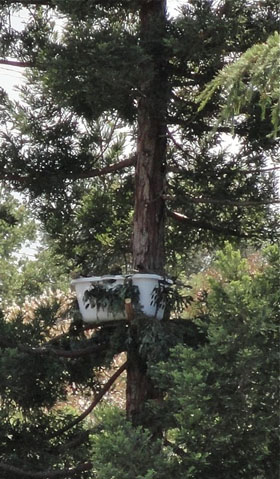


UPDATE: Today, Duane and Rebecca returned to find one of the parents in the new nest with the chick. This is GREAT news!!!

On a sad note, however, we learned that one of the other chicks was so badly injured it had to be euthanized, and the other chick is in critical condition.

WildRescue will be working closely with the Wildlife Center of Silicon Valley to see if the chick recovers, or if there are two healthy chicks of the same age that we could foster into this dedicated hawk family.

Stay tuned!


May 24, 2012

Barn owls know no borders

Israeli and Jordanian farmers choose to use barn owls rather than poisons to control pests in their fields. Check out the video below:


May 23, 2012

Entangled gull in Berkeley

This morning, we received a call from a woman reporting a gull, tangled in fishing line and stuck to something underwater near the Berkeley Marina. With a hook through its upper bill and several weights on the line, it could barley raise its head above the water, and the tide was rising.


Johnnie K. from Berkeley Animal Control was quick to respond. With help from Berkeley Marina, Johnnie was able to approach the bird from a boat. He scooped up the waterlogged gull, entangled it from the line, and it was transported to International Bird Rescue in Cordelia. Way to go Berkeley Animal Control!!!


UPDATE: We checked in with the bird hospital on the 25th and we're told the bird is still alive. That's great news!


May 22, 2012

Bay Area Proud

Last Friday, Duane and Rebecca were joined by Garvin Thomas, of NBC's Bay Area Proud - a news segment about people doing good. We were honored to have been chosen for a piece. Here's the LINK.


THANK YOU GARVIN!!!!! THANK YOU BARBARA!

May 21, 2012

Personal note from Rebecca:

I have been rescuing wildlife for over thirty years and it never gets easier to witness situations like this.
I was contacted about a severely injured gull in Alameda. Both its legs are entangled in fishing line and bound together, but it can fly. 
Flighted birds are some of the most difficult to rescue. 
It's not just that they can fly, but injured animals are typically more wary and reluctant to 'bait in'. If pursued by well-meaning people trying to help, animals become harder to approach and may even disperse from an area altogether if they are continuously harassed. 

These types of rescues require special training, skills, and experience. These types of rescues can take time - days, even weeks, to accomplish.
We were first notified of this gull one week ago. The call was transferred to us by another Bay Area rescue group. I quickly sent out requests to our network of volunteer responders with little luck in finding someone to help. 
I feel for the person who reported the gull. She has been trying desperately to find help for the bird - calling everywhere she can think of. Nearly every day she visits the location where the bird frequents, watches out for it. Helpless and frustrated, she watches this animal suffer, day in and day out, and no one coming to help. 
Reliant solely on volunteers, we find ourselves, once again, unable to respond as we'd like to and as we should be able to. 
This animal's needless suffering continues from a lack of local available resources. The solution is an on-call 24/7 wildlife paramedic. 
For the last few months, we have been focused on raising funds for a Bay Area Wildlife Ambulance.
We know we can make a difference with the Bay Area Wildlife Ambulance This animal is a perfect example of why it is so desperately needed.
We have a new way to give - through ChipIn. Click HERE, or the link below. Help us get this wildlife ambulance up and running, once and for all!

Here is an account by someone who watched a goose, tangled in line, go months without help. Finally, she called WildRescue and we were able to respond quickly. This further illustrates the need for a Bay Area Wildlife Ambulance.
SAD ENDINGS FOR TWO MALLARD DUCKS AND ONE CANADA GOOSE 
By CynthiaApril 02, 2012 
HOW THIS STORY STARTED 
I discovered two injured Mallard ducks and one Canada Goose.  In October 2011, I started to call a local animal rescue organization to seek help for these injured birds but ended up making calls to multiple animal and wildlife rescue organizations and got nothing but excuses as to why they cannot come out to rescue these birds. Instead, all the help they provided me was to refer me to another animal or wildlife rescue organization.
Finally on February 28, 2012, I was given the telephone number of WildRescue in Moss Landing. I made contact with Rebecca Dmytryk. One of their responders, Deanna, met with me on March 2nd at the lagoon and with patience she was able to capture the injured Canada goose. Deanna had to make a nearly 1 and ½ hour one-way drive to Sunnyvale to make this rescue. Unfortunately, after Deanna took the injured bird to a wildlife hospital, the bird had to be euthanized because of the seriousness of the long-term injury. If only I had been able to secure help back in October, this Canada goose, and perhaps the two Mallard ducks, would be alive today.
Nobody could say yes, we will come out and rescue these birds.  Only WildRescue who is far away told me yes they would absolutely come out to help. Here is a sampling of some of the advice that I got:
·      “Let nature take its course.”
·      Just throw a towel over the goose, put it in a box, take to a veterinarian in San Jose (they gave me an address).”
·      “We do not rescue ducks or geese.  We only rescue predator birds like owls or hawks.”
·      “If it bothers you to see the injured goose, then stop walking over there!  Just do not go to the lagoon anymore.”
·      “We do not know who can help you.  There are only two animal control officers.”
·      “We do not rescue – we just educate people.  Sorry, we cannot help you.  We do not have equipment to get the goose.”
·      “We only have volunteers and there isn’t anybody available.  Also we do not rescue injured ducks or geese.  Let nature takes its course or you will have to take it to a veterinarian yourself.”
·      “It is showing up on my screen that there is no body of water in that area that belongs to the city.  It is privately owned.  You will need to contact the owner.”
·      “Call the police department to rescue the ducks and goose.  They will come out when you call.”
·      “If the birds are limping, we do not rescue them.  It is probably a minor injury and they will heal on their own.”
 
Photo from Wildlife Center of Silicon Valley.
Guess what?  It turned out that the Canada goose had fishing line wrapped tightly around her upper leg. Fishing line is transparent and you cannot see it wrapped around the goose’s leg. So this is not a minor injury after all. It caused much suffering for at least 5 months for this goose and eventually had to be euthanized. As I write, there are other ducks that are limping. Perhaps they too have fishing line wrapped around their legs. We should not assume that a limping bird has a minor injury. These creatures end up suffering and losing their lives because of humans trashing up the environment. 
Thank you Rebecca for caring, even if it is a bird, you believe we have a moral obligation to help an animal in distress. I wish I knew about your organization, WildRescue, back in October 2011. Also, thank you Deanna for driving the long distance to rescue the Canada goose. You were professional, patient, and showed compassion. 


May 19, 2012

Deer ordeal


This week we were transferred a call about a female black-tailed deer (a subspecies of mule deer) that had, evidently, jumped over a fence from a hilltop property and into an adjacent yard, downslope. There, she gave birth to two fawns.

Unfortunately, though, she and her young ones were trapped. Not only would she have a tough time clearing the fence, but even if she managed to, there was no way for her fawns to follow.

Her freedom was not the only concern, however. On either side of the small residential lot, dogs patrolled the fence line, barking and trying to dig through to get to the deer. 


Also, the hillside had been mowed recently, leaving little room for the animals to hide, and reducing their supply of nutrient rich grasses. The property owners also admitted to feeding the doe apples - a huge No No.

The doe and her fawns had to be freed.

Here is Rebecca's personal account of what transpired:

Going into this, Duane and I had no idea what a difficult time we would have, especially given the report we received from the organization that had initially responded. According to their account, both the RP (Reporting Party) and the land owners were very concerned for the welfare of the deer. It turns out, they were overly concerned.  
We began by looking at a map to help us figure out the direction the doe had come from and, therefore, would be most apt to leave. We also wanted to plot the safest course for her to get back 'home'. 
Even though we were in the middle of a residential subdivision, wildland was only blocks away - maybe 1000 yards, and deer were commonly seen roaming the neighborhood's quiet culdesacs. 
With a plan in mind, we contacted the RP to make sure they were alright with the idea of us opening up the fence and herding the deer family back onto their land. Their property was quite large, with lots of cover, plus the deer could leave when they wanted to. 
Next, we made contact with resident where the deer was entrapped. It was late afternoon when we knocked on their door. We gently introduced the idea of allowing the doe and her young to leave their yard - either through the front gates or allowing us to unbolt their chain link fence, temporarily. 
After the door closed on us mid-sentence, we had no choice but to alert the authorities - the California Department of Fish and Game.
Deer are considered Big Game, and they are strictly managed by the Department, not just because they are hunted, but because they are extremely dangerous to deal with. To rescue or rehabilitate big game requires special authorization from the agency, so we were required to keep the region's Captain apprised of the situation. 
Additionally, the deer being entrapped and the land owners resistance to freeing them bordered on possession. It is illegal to possess a wild animal in the State of California without proper authorization from the Department.
In less than 15 minutes, one of the local wardens arrived on scene to take over. We were there to assist as needed, but it would be their call as to the final outcome. 
After speaking with the warden, the residents conceded to the idea of allowing the doe and her twins to leave through the back fence, but they would not allow Duane or me on their property. 
Duane and I accessed the fence line from above, through the RP's property. As we approached, the doe became nervous, understandably - we were in her 'safe zone'. Also, the land owners refused to go inside their home, which caused the deer more angst. 
Duane swiftly removed the bolts holding up the chain link, and spread it open. We backed away and alerted the warden that it was all clear. 
Ideally, Duane and I would have driven back down to the other property to control the amount of 'pressure' (predator presence) on the doe. They are skittish animals and panic easily. If threatened, prey animals will do anything to escape, even if it kills them. 
We believe we could have encouraged the doe to gather her young and leave quietly. It may have taken an hour, but it would have been best. Unfortunately, the resident would not hear of it. So, all of our hands were tied. 
Duane and I backed away from the fence, leaving the doe plenty of room to leave, unthreatened, while the warden applied a small amount of pressure. Finally, she bolted out the opening, leaving her fawns behind. 
The fawns were collected, one by one, and placed outside the fence. Unfortunately, there wasn't much we could do to oversee the reunion - the repair of the fence had to come first. Under the watchful eye of the 'lady of the house', Duane and I re-attached the chain link. 
By the time we were finished with the fence - leaving it in better condition than it had been, it was nearly dark. Although we didn't actually see the doe with her fawns, we felt confident she would find them. 
Today, we sent one of our experienced responders back to check on the situation. She did not find either fawn, but did locate the doe, peacefully bedded down in cool shade. 
For now, we believe the family is intact and doing well. We will check back on Monday.  
A huge THANK YOU! to the Department of Fish and Game for their timely response to this situation and for their ongoing efforts to protect and preserve our State's wildlife!


Ducklings down the drain


Earlier today, we received a call from Santa Cruz Animal Control Officer, Carlos, requesting assistance in getting a batch of ducklings from a storm drain. He'd managed to retrieve three of the babies with help from City of Watsonville Fire Department, but seven more were still in the system.

Using one of the Fire ladders, Duane descended into the storm drain and
 found six ducklings traveling under the road, headed for another drain entrance.

The firemen lifted the heavy metal grate to gain access, then lowered a long handled hoop net to block the ducklings escape.


With the net held vertically in place, Duane crawled on hands and knees, 'pushing' the ducklings along until, finally, they were inside the sock of the net.
 

The downy chicks were carefully lifted out and placed into an awaiting pet carrier as the mother hen watched, nervously, from a distance. One more to go!

One of the ducklings had become separated from its siblings and was headed down another channel. Again, the next nearest manhole was opened and the large net lowered to the bottom. This time, though, the duckling backtracked right into Duane's hands.


Once all of the babies were safely inside the pet carrier, Mama Duck was led to a wooded, marshy area where she was reunited with her babies.

Thanks to everyone involved! It could not have gone any better!!! Bravo!


May 13, 2012

Recognition


Donations to Naoto Matsumura

Finally, we have received confirmation that we have the correct bank account for Naoto Matsumura, the 52 year old farmer who stayed behind to tend to the animals after the Fukushima nuclear accident forced everyone else to leave.
In our January 2012 blog post about this brave and extraordinary man, we offered to collect donations to help him feed the hundreds of animals he cares for.


On May 8th, we wired $635.00 of your donations to Matsumura-san! Thank you, Katherine, Danielle, Silvia, Tresia, Ms. Hirayama, Marc, Sal, Marcela, Rodney, Maeve, Stephen, Rupa, David, Susan, Emilia, Andrew, and Marinell!


In researching contacts for Naoto Matsumura, we became acquainted with Nanci Caron, who has been coordinating a worldwide effort to raise awareness and support for Matsumura. 
This is her web site, HERE. To make a contribution to Naoto Matsumura, go HERE.

May 11, 2012

Midway: Message from the Gyre

Photo: Chris Jordan

Photographer and artist, Chris Jordan, and his production team explore the cycle of life and death on Midway Island, where tens of thousands of albatross chick carcasses litter the land, their open bellies exposing an environmental tragedy. 


Please, view the trailer of his incredible film, Midway: Message from the Gyre, still in production, HERE.


Donate to support the Midway Project, HERE.
Stay connected with Chris and the Midway Journey project on Facebook, HERE.


Please, watch Chris' powerful and revealing talk on TED, below.


May 9, 2012

Saw-whet saga continues

Near Memorial Park, Loma Mar, CA, where the owlet was discovered.

Last week we wrote about the little orphan saw-whet owl, found on a road in Loma Mar, CA. This week, efforts to reunite it with its wild family continued:


We reached out to the birding community, asking for help in locating the owlet's family and received a quick response from Jeff and Jessica, a couple from Half Moon Bay.


Monday evening, Jeff and Jessica set out to look for a nest or find an adult saw-whet in the area where the baby was found. Here is their account:


Jeff scanning for owls or signs of a nest.
We were able to find the location easily, and actually talked to one of the rangers who knew exactly where the bird was found. We searched the trees immediately surrounding that spot pretty thoroughly during the light and couldn't find any sign of owls - either roosting, pellets/whitewash, or cries from the nestlings. 
As it got dark, still no sign of owls. On and off we heard some noises that COULD have been nestlings, but nothing conclusive and more likely just standard forest noise as the night was coming and animals were either bedding down or waking up. 
However, after waiting for a few minutes of full darkness, we played some recorded Saw-whet cries. That brought cries in response from what sounded like pretty high above. Then a hoot sequence brought a long sequence of hoots in response - again from what sounded like pretty high up in the conifers. 
The second time we played the hoots, an owl flew down for a closer look. We were able to watch it for a while and then is gradually lost interest. We repeated the hoots again in a slightly different area and it again came in (this time swooping to within a couple feet of the iPod!) to investigate. 
I don't know enough about owl behavior to know if this means the owl we saw was protecting a nest... or looking for a new mate since the original nest failed... But there is definitely at least one adult Saw-whet in that spot.

With this new information, we consulted raptor reuniting specialist, Anne Miller, in Alabama. She felt we should place the owlet in a nest-basket and try calling in the adult. First, though, we needed to see how the baby owl would act in the basket - would it stay inside, or try to get out?

Dress rehearsal at the Peninsula Humane Society Wildlife Care Center: Patrick and his team created a wonderful nest-basket with a cover - almost like a cavity nest! Check out the video of the little owl in his new digs:


Now it was time for the real deal.

Tuesday evening, Duane and Rebecca rendezvoused with their newly indoctrinated wildlife responders, Jeff and Jessica, who had picked up the owlet, nest-basket and go-bag from the Wildlife Care Center.

The team started by looking for a suitable tree. Then, Duane got to work on hooking up the infrared camera while Jeff, Jessica and Rebecca attached branches and foliage to the basket.


Rebecca also attached a piece of plastic netting on the top of the basket. She was concerned that the active brancher might climb out, flutter to the forest floor and be lost.
Once everything was in place, the owlet was set inside the nest-basket. Duane and Rebecca monitored the scene from the rescue vehicle, while Jeff and Jessica, hidden in the brush below the owlet, played saw-whet vocalizations, hoping to attract its parent.

At near 10:00 pm, after a good hour of trying and not a single response from an adult saw-whet, the team called it a night and started packing up.

Rebecca untied the basket and was gently lowering it, when she realized the owlet was missing. Sure enough, the owlet had managed to escape under the cardboard top! Panic set in - the thought of trying to find a small brown and buff colored creature on the forest floor in the dark! It wasn't more than 30 seconds before he was found and 
returned to his basket where he was offered a meal - a thawed dead mouse.


With the owlet in care at the Wildlife Care Center, we're still hoping the owlet can be returned to his wild home. Perhaps someone in the Loma Mar area will allow us to build a small mew that can be used as a soft-release enclosure. Anyone interested should contact rebecca@wildrescue.org.

Just to give some perspective, this map shows the region and the territory covered. 
While the process of reuniting wild babies can be labor intensive, it is in the animal's best interest.


THANK YOU!!!! to everyone who helped in these efforts to reunite the little owl!


May 8, 2012

Barn owl caught on line


This morning, we were called out on an emergency involving a barn owl caught on some sort of line - either kite string or fishing line. It was tangled by its leg and snagged on branches of a cottonwood tree, some 30' high. Duane, Rebecca and Ron Eby responded.

The situation was dire. The animal was exposed to full sun, and the temperature was rising. In its panicked state, the animal could easily overheat. To complicate matters, the tree was located at the back of a residential property with no way to drive in a mechanical lift. Even if we could bring in heavy equipment, the ground was saturated and boggy.

Duane and Ron laid out wooden planks on which they set a tall ladder. For extra security, they tied the ladder to posts driven into the ground. Hoping to secure the line and lower the entangled raptor to the ground, Duane used an especially long pole with a hook on the end.

He managed to get hold of the line, but, unfortunately, the line snapped and the owl flew off to a grove of trees, blocks away.

The good news is that the line remaining on the bird's foot was now very short - something we hope the owl can manage to work off.

If WildRescue receives any reports of this owl being sighted, a team will try to trap the animal so the rest of the line can be removed.

Interestingly, the team found a freshly killed gopher in the grass below the entangled owl. Piecing together bits of information, they believe the owl snatched the gopher from a nearby yard and may have picked up the line at the same time. As the owl was flying, trailing some 20' of line, the line got caught up in the branches of the cottonwood.

This is a great example of how litter, like discarded line or string, can be a real threat to wildlife. Be sure to pick up any pieces of line you find, and dispose of it properly. Long pieces should be cut up before its thrown away.


May 5, 2012

Little orphan saw-whet

Earlier this week, our colleagues at the Peninsula Humane Society Wildlife Care Center received a young Northern saw-whet owl. It was found on a maintenance road in Memorial Park, near Loma Mar. 


The owlet arrived weak and dehydrated, leading us to believe it had been without parental care for at least one night. Even so, we all agreed that if the owlet recovered fully, reuniting should be considered.


To reunite a healthy baby with its wild family, one must be well-acquainted with the natural history, or life history, of the species involved. This body of knowledge provides details on nesting behavior, for example, saw-whet owls are cavity-nesters, relying on previously excavated cavities. 


We also know that male saw-whet owls provide food to the female while she broods their young, although there are accounts of males providing food for other females and their young. Females leave the nest when the young are approximately 18 days old, when she either joins her mate in rearing their young, or leaves to mate with and raise young with another male. The young fledge at about 4-5 weeks of age, when they are nearly able to fly, but they remain together and in the care of their parent(s) for at least one more month. 


Within a couple of days, the little orphan saw-whet had regained its strength and was officially 'out of the woods'. It was time to consider taking him home, but we had to be sure there was at least one parent to care of him.


Last night, two of our responders volunteered to do a stakeout. They met up at the exact location where the owlet had been found and sat quietly in their cars, listening for begging calls from the owlet's siblings. There was nothing.


Today, Maureen returned to the location to do some more detective work, looking for any signs of an active nest or an adult saw-whet.


By day, a saw-whet owl will stay hidden in foliage, roosting on lower branches. Come nightfall, saw-whet owls will use a 'sit and wait then pounce' tactic to secure a meal. They feed primarily on small mammals but will also eat frogs, insects, and occasionally smaller birds.


A HUGE TAHNK YOU TO SUSAN AND MAUREEN FOR GIVING UP THEIR FRIDAY NIGHT TO DO A STAKEOUT!!!!


And many, many thanks to the wildlife rehabilitators at the Peninsula Humane Society Wildlife Care Center!!!


Apr 26, 2012

Fishing line blues

Photo courtesy Alejandro Gallo
Ironically, on Earth Day, as WildRescue celebrated its second annual Worldwide Fishing Line Cleanup Day, we received a report of a great blue heron with a bad fishing line injury. The bird was discovered in the Los Angeles River by wildlife photographer, Alejandro Gallo.


The species is known for being wary and skittish, and the bird is still flighted, making this an extremely difficult rescue. To develop a capture plan, it helps to have as much information as possible. In this case, we need to know where this individual bird likes to hang out during the day and what time it arrives.


Thanks to Alejandro and one of our responders, Zack, we can count on the bird frequenting a particular place, daily. It's a precarious spot, though, and the river and thick brush along its banks complicate matters. Ideally, the heron should be enticed into a better spot for netting or trapping. 


Photo courtesy Alejandro Gallo
Rescuing these kinds of birds can be tricky, and the preparation can take days. Captures, like this one, that require luring an animal, can require hours and hours of waiting. It's not easy finding people who are willing and able to perform these types of rescues.


Unfortunately, at this point in time, WildRescue does not have enough responders in Los Angeles area to carry out this rescue safely. We are currently reaching out to other entities who may be able to help, but it doesn't look promising. 


The majority of wildlife hospitals leave the capture and transport of ailing animals in the hands of the public or the local Animal Control. WildRescue is one of the very few wildlife organizations in the country that offers field response, but at this time, its program depends on volunteerism, which has wained with the economic downturn.


Anyone interested in volunteering to help rescue wildlife in the Los Angeles area is asked to  email rescue (at) wildrescue (dot) org.


Apr 25, 2012

Snakes in Watsonville


Today, two garter snakes were found denning together at a residence near Harkins Slough in Watsonville. We believe they are Monterey coast garters.


The two were resituated, together, on a piece of undeveloped property near the slough.


Rocky

A personal account... 
It was close to 9 o'clock last night, when we received an emergency page about a thumb-sized, naked baby bird. Nearly all rescues begin with an initial phone conversation where Call Takers turn into big-time detectives, but first, we must focus on the animal's immediate needs. 
Through a barrage of questions, the finder described how he'd found the hatchling, hours earlier, outside his home in Los Angeles, on a cement slab. 
Hours earlier was not good news. Where has the bird been housed these few hours? 
The man had placed the baby inside a box in the garage, thinking he was doing all he could. 
As a rule, newborn animals cannot thermoregulate. They chill quickly in the absence of a parent or siblings. If they get too cold, they will die. The baby required supplemental heat, and fast. 
I quickly walked this kind, gentleman with a baritone voice through a labyrinth of emergency baby-bird-care instructions. I directed him on the correct temperature. The ambient temperature around the baby has got to be between 85-90 degrees for most hatchlings. Then i guided him on making a temporary cup nest. All the while, i imagined big male hands fumbling with paper towels and tissue,... and i imagined the heart behind it. The kind of goodness in a human that gives me a glimmer of hope for the future of this planet and its inhabitants. I couldn't help but smile while listening to him follow my instructions.  
Take a paper towel and twist it into a cord, then tie a knot, then weave the ends. Place a tissue over the bowl shape and depress the center. Set this 'nest' inside something shallow, but sturdy, like a custard dish. Place the little baby bird in the new little cup nest, with the bulkiest part of its body in the center, okay? Good.
I was really impressed with the man-on-the-other-end-of-the-line. He did a great job with the nest, and even though he couldn't find an electric heating pad, he ingeniously figured out another solution for heat - a clamp-on work light (of course). He kept it just far enough away to provide warmth, but not so close that it could burn the baby. Good job!
Now, as the baby bird was warming, we could focus on where it might have come from.
Nestling altricial birds are heavy-bodied and and not very mobile, so, unless it rolled, or was displaced by a cat or nest-robbing corvid, the nest would be nearby, usually above.
With this in mind, the fellow described a small hole where electrical conduit entered the home - he noted what appeared to be nesting material sticking out on either side of the pipe.  
This made me think the baby was a non-native English sparrow or starling, if i had to guess. They are cavity nesters, common in urban areas.
Once the baby was warm enough, we could try feeding it. 
Generally, this is not something we ask finders to do - only in emergency situations where the life of the animal is in jeopardy. 
Diurnal birds do not feed their babies at night, but it had been hours since the baby was fed. Two small feedings should do.
I walked him through the process, step by step. How much can this guy take? 
You can soak a few kibbles of dry dog food until they are moist and spongey, but make sure that when you deliver a bit of kibble, that it is not soaking wet, where it will produce a big droplet of liquid, as the baby might aspirate - take fluid into its windpipe located at the very back of its tongue. Using a dull but pointy object (yeah, right), try to get the small blob of food as far back in the throat as possible - the baby will help by pushing upward. Don't freak out... just do it.
The next morning: 
Rocky, as the family had named the orphan, made it through the night! Now we needed to work on either returning him to his nest, or finding a licensed rehabilitator willing to take a non-native bird. I sent word through an online List.
As we waited for a reply, Rocky was cared for throughout the day - fed regularly and the tissue of his paper-towel-nest changed often to keep him clean. His carers also kept an eye out for parents.
There was no activity at the hole by the electrical panel, but there was activity at a nest some 15' away under the eaves. They described a 'burrito-shaped' nest with an entrance on one side.
At some point during the day, the family connected with one of the rehabilitators. Taking their advice, they placed Rocky on the ground near the active nest with the understanding that the parents may have had multiple nests and were relocating their babies when Rocky was lost.
Okay, hold on a minute. I am sure there was some miscommunication along the way. 
To be clear, birds don't do that. They are incapable of moving their babies in that way. The only birds that move their babies are the precocial species, like ducks and geese and the like.
Here's what ended up transpiring: 
Lots of activity at visible nest, but mama wouldn't pick up Rocky, so after about an hour or so, my father in law carefully placed the bird into the nest by finding the opening, and feeling for an area of warmth. Then, the mama went in and stayed there for a while, then began leaving and emerging - normal behavior.  Later we looked around the nest to see if 'Rocky' had been ejected, but no sign.  We can only assume he is in the nest, and hopefully alive and well.
 As of yesterday, all seems well:
As far as we know Rocky is in there, this morning we watched as mama would fly out and get food and come and feed the kids every 5 minutes or so.  Papa sits on a telephone wire nearby and keeps lookout.  The kids chirp like mad when she goes in to feed them... it's great to watch...
GREAT JOB!!! WELL DONE! 
Stay tuned...


Apr 24, 2012

Net loss

This morning, we received a call from the owners of an organic farm on a remote portion of the San Mateo coast - a bobcat had gotten stuck in the portable electric poultry fencing used to enclose their chickens. The cat had killed a hen, but didn't clear the netting as it tried to escape.


Duane and Rebecca met another WildRescue responder, Mary Kenney, at the ranch. The team reviewed plans to restrain and untangle the cat, then heading across the field. Once in view, they realized the animal was serious trouble.


With the cat unconscious and hyperventilating, Rebecca restrained the head while Duane quickly cut away the wire mesh that was wrapped tightly around its midsection. As the cat was lifted inside the carrier, it let go a stream of urine.


Back at the transport vehicle, the team soaked the cat's fur with cool water, hoping to bring down its elevated temperature. They were on the road in minutes, heading for the nearest animal hospital, but, sadly, the bobcat never regained consciousness and died en route.


In retrospect, we will never know how long this animal was entangled - it could have struggled for more than 12 hours before it was noticed, and even if responders could have been on scene within a few minutes, the damage from the cat's frantic attempts to free itself might not have been reversible. 


Either way, we are very saddened over the loss of this otherwise healthy wild animal, but very, very grateful to the landowner for calling us to help.


Apr 20, 2012

Great horned owlets reunited!


This morning, we received a call from the Wildlife Center of Silicon Valley about two healthy great horned owlets. They had been found the evening before by Lynda, from Chaparral Ranch. 


While out for a ride Lynda noticed the babies at the base of a eucalyptus tree near Sandy Wool Lake. Thankfully, she recognized they were too young to be on the ground.


At about 2:00 PM today, Lynda met up with WildRescue's Duane and Rebecca to direct them to the exact tree. Scat and owl pellets littered the ground - a sign that they had found the spot. About 14' above, they identified the remains of the nest. It appeared as though the nest of eucalyptus twigs and bark, had simply disintegrated. Our team quickly went to work constructing a new nest for the family. 


Using a laundry basket, they attached limbs to the sides for perching, and lined the inside with dry vegetation. Holes in the bottom would allow for drainage. Laundry baskets make excellent replacement nests for great horned owls. There is documentation of a pair using a laundry basket for nearly a decade!


As the new nest was being secured to the home tree, the baby owls were delivered by Ashley Kinney, Wildlife Rehabilitation Supervisor at the Wildlife Center. With everything in place, the owlets were carefully hoisted into the tree and set into their new nest.


During all of the commotion, the adult owl had remained in place, watching. Once the team had cleared the area, the adult appeared fixated on the nest.


The nest will be monitored to see that the parents are caring for their young. We have every reason to believe they will.


Check out more on reuniting great horned owls and other raptors at Anne Miller's site, HERE.


We want to say a huge Thank You! to Chris from Bellizzi Tree Service for once again offering to help!


4-24-12 UPDATE: At about noon, one of the parents was sitting in the nest with the babies.


Apr 16, 2012

Goose at Apple

Today, received a call today about an injured Canada goose in one of the parking lots at Apple Inc. in Cupertino, CA. According to the RP, it had been there for a week. No one had come to its rescue.


We alerted our responders. Sammarye, in Sunnyvale, was quick to reply. She met Rebecca on scene.


The goose appeared to have a swollen leg, but was still flighted, although weak. Rebecca first tried coaxing the bird close, but it was too wary. Next, the team tried a single snare, but that didn't work well, so they decided to try the Drive By.


They placed a few handfuls of grain to preoccupy the goose. With Samm at the wheel and Rebecca crouched inside the back of the van with both doors open, they made a couple of passes. With each pass, the goose seemed to get a little more comfortable with the vehicle.


On the third pass, Rebecca lunged, bagging the goose in a large hoop net. Samm stopped the immediately and helped process the large bird from the net and into a crate. 


The bird was transported to the Wildlife Center of Silicon Valley for treatment.


UPDATE: According to WCSV, the goose was dehydrated and notably lethargic. Her slight wing droop leads them to suspect lead poisoning. They expect lab results early next week.


Stay tuned.